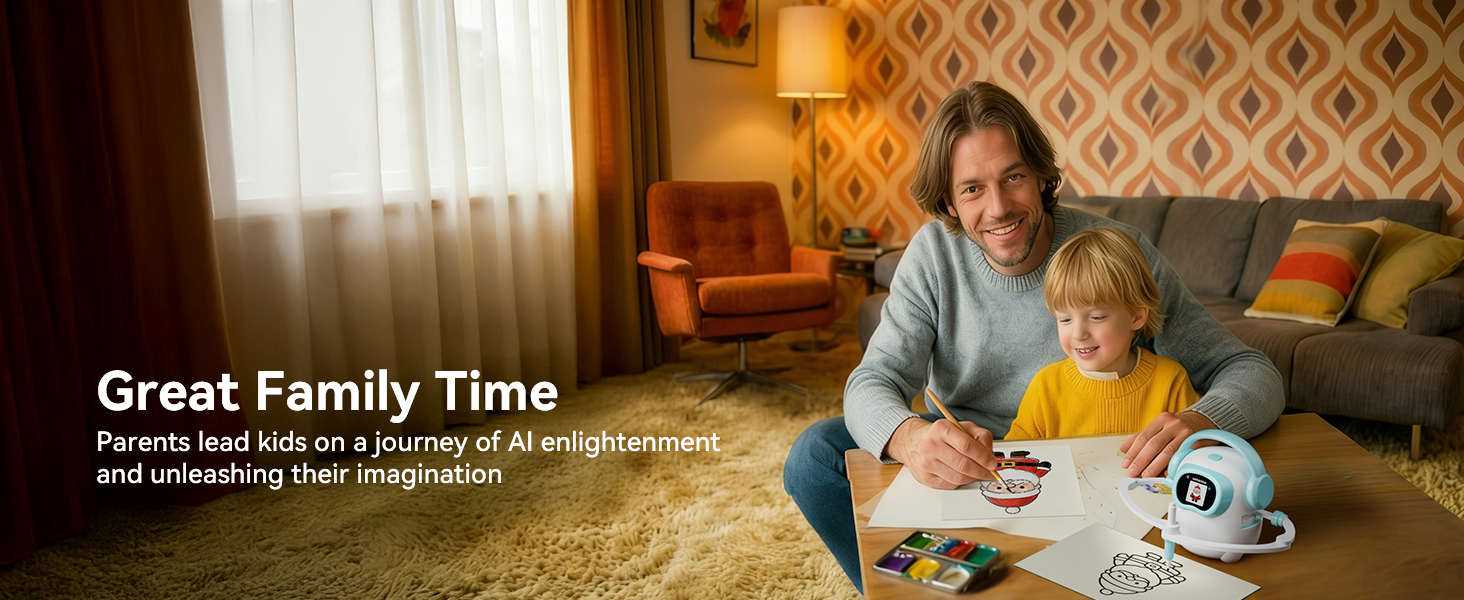
The kids who grow up alongside AI are going to be very good at one specific skill: knowing exactly what to ask for. They'll do it without calling it "prompt engineering." It will just be how they talk to machines. The question for parents in 2026 isn't whether to introduce kids to AI — they're already going to encounter it — but how to do it well, before bad habits set in.
What "prompt engineering" actually means (in plain English)
Forget the jargon. Prompt engineering is just the skill of describing what you want clearly enough that something capable can act on it. You already use it every time you order a coffee with three modifications, brief a contractor, or text your partner what to pick up on the way home.
With AI, the "something capable" is a model that can generate text, images, music, code, or — in the case of an AI drawing robot — actual marker strokes on paper. The skill is the same: be specific, iterate, refine.
Why this matters for kids ages 3-8
Three reasons:
- The window is open. Ages 3-8 is when kids rapidly build descriptive language. Practicing precise description on something that gives instant visual feedback (the AI draws whatever they say) builds vocabulary much faster than abstract teaching.
- Iteration is the actual lesson. The first prompt almost never produces what the child imagined. They learn — by doing — that you refine: add a color, change the action, specify the setting. This generalizes well beyond AI.
- It builds healthy expectations. A kid who understands that AI responds to what you describe won't treat it as magic or oracle. That's the right mental model to carry into the next decade.
The good news: you don't have to teach it directly
Kids learn best when they don't realize they're being taught. The best moves for a parent are simple, low-effort, and feel like normal play. Here are five exercises that work, ranked from least to most structured:
1. The "describe a creature" game (no AI required)
On a walk, in the car, at bedtime — pick a creature and have your child describe it in three sentences as if you couldn't see it. Then sketch what they describe. The mismatch between intent and result is the entire lesson. Reverse roles: you describe, they sketch. This is a prompt-engineering rep with zero technology.
2. The "specifier" challenge
Pick a noun ("dog"). Ask: "What kind?" "Doing what?" "Wearing what?" "In what place?" Each question is a prompt-refinement move. Within minutes a 5-year-old will be saying things like "an orange dog wearing sneakers, jumping over a swimming pool." That's a usable prompt — for a human or an AI.
3. The "guess the prompt" mirror game
Show your child an image (a book illustration, a photo, a drawing they did last week). Ask: "If you wanted an AI to draw this, what would you say?" Then have them say it out loud. You're teaching reverse-engineering — looking at output and inferring the instruction. This is an underrated skill.
4. The voice-activated AI drawing robot loop
A toy like the iBeed AI Drawing Robot is purpose-built for this. The child says the wake word ("Hi, Joy"), describes what to draw, and watches a robotic pen translate their words into a drawing on real paper. The first attempt is usually too vague. They iterate. Within a week they're refining their requests on their own. The toy is incidentally an AI-prompting trainer disguised as a craft activity.
For the technical breakdown of how voice becomes a drawing, see our explainer: How AI Drawing Robots Work: A Parent's Guide for Ages 3-8.
5. Co-prompting with a parent
Once your child is comfortable, occasionally sit with them and co-write a prompt out loud. "What should we ask for?" → "A unicorn." → "What is the unicorn doing?" → "Eating cereal." → "OK, let's say 'a purple unicorn eating cereal at the breakfast table'." Saying it out loud — and watching the result — wires the loop into long-term memory.
Three things to NOT do
Don't lecture. Don't quiz.
The whole point is play. The moment it feels like school, kids disengage. Let the toy or the conversation do the teaching.
Don't correct their prompts.
A "bad" prompt that produces a weird result is the most useful teaching moment they'll have all week. Let the result do the correcting. Just ask "what do you want to change?" and try again.
Don't outsource to the screen.
The biggest red flag in any AI toy or app is one that turns the kid into a passive viewer. Look for tools where the child has to do something after the AI responds — color over the outline, re-prompt for variations, tell a story about the drawing. The output should be a starting point, not the destination.
What success looks like (and how to spot it)
A few weeks into casual practice, watch for these signals:
- Your child starts describing things in clauses: "the cat with stripes that's sleeping on the couch" instead of just "the cat."
- They iterate without prompting from you: "no, make it BIGGER," "add wings," "this time it's purple."
- They predict the result before it happens: "the AI is going to draw it on a beach because I said beach."
- Most importantly, they treat AI as a collaborator they can guide — not as magic and not as a god. That's the whole game.
The bigger picture
In ten years, "prompt engineering" will not be a job title. It will be table stakes — like keyboard typing was for the millennials. The kids who learn it through play, in low-stakes contexts, with parents who don't make it weird, will have an enormous head start. Not because they'll be AI experts, but because they'll be fluent collaborators with whatever tools exist by then.
The good news for parents: you don't need to learn anything technical, buy expensive courses, or sign your kid up for a coding bootcamp. Just play the games above. The hardest part is resisting the urge to correct.